MODULE 2 · LESSON 10 · 11 MIN
Model Evaluation: Benchmarks, MMLU, and Why They're Imperfect
By Siten Sanghvi · Published · Updated
A benchmark score tells you how one model did on one fixed test, under one set of conditions. It does not tell you how good the model is overall, and it does not predict how good it will be at your work. Treat a score as evidence to check, not a final grade.
In 2023 the GPT-4 technical report listed 86.4% on MMLU, a well-known knowledge test. Later that year Google's Gemini report listed 90.04% for Gemini Ultra on the same test and called it the first model to pass an estimated human-expert level. Yet the same table shows Ultra at 83.7% under the 5-shot method behind GPT-4's number (5-shot: five worked examples in the prompt). The 90.04% used a more expensive method: sample 32 reasoning chains and use their consensus when it is strong enough. The table also lists GPT-4 at 87.29% under that same 32-sample method, so the headline gap mixed a method difference with a model difference. (These are historical figures from the vendors' own reports, checked 2026-11-09, not a current ranking.)
Why evaluation is hard
A model can be strong at writing and weak at arithmetic, or accurate on exam questions and unreliable in a real conversation. No single number captures all of that, and a model that leads on one task can trail on another.
The standard response is the benchmark: a fixed set of tasks with a scoring rule, so different models face the same questions. A fuller picture needs many benchmarks. The HELM project argued for that, scoring models on many scenarios and on measures beyond accuracy, such as calibration (whether stated confidence matches accuracy) and toxicity.
Common benchmarks and what they test
MMLU (Massive Multitask Language Understanding) is a set of multiple-choice questions across 57 subjects, from elementary math and history to law and professional medicine. Students collected 15,908 questions from freely available practice exams and course material. Questions have four options, so guessing scores about 25%. The authors estimated expert-level accuracy at about 89.8%, a rough figure built from high-percentile test-taker results on the source exams, with educated guesses where data was missing.
HumanEval has 164 hand-written Python problems, each with a function signature, docstring and unit tests. A problem counts as solved if any of k generated attempts passes the tests. That is pass@k. Pass@1 is one try; pass@10 allows ten.
HellaSwag asks a model to choose the most plausible continuation of an everyday scenario from four endings. The authors measured 95.6% for humans; the wrong endings were machine-generated to fool models of the time.
TruthfulQA has 817 questions in 38 categories, chosen because people often answer them wrongly from misconceptions. It probes whether a model repeats common false beliefs.
GSM8K is 8.5K grade-school math word problems that need several steps.
MT-Bench uses a strong model, such as GPT-4, as a judge to score answers to multi-turn questions. In the paper that introduced it, the judge agreed with human preferences over 80% of the time, about as often as humans agreed with each other. The same paper lists judge biases: position, verbosity, self-preference (the paper's term is self-enhancement) and weak reasoning.
Chatbot Arena is a human-preference system. A user asks a question, sees two anonymous answers, and votes for the better one. A statistical model turns many pairwise votes into a ranking. It measures what its voters preferred, which is useful but not the same as accuracy.
Where a score misleads
Saturation and bad answer keys. When top models cluster near a benchmark's ceiling, small gaps stop meaning much. In 2024 the MMLU-Pro authors said MMLU performance had begun to plateau, making models harder to tell apart, so they built a harder version with ten options and more reasoning. Accuracy dropped by 16% to 33% compared with MMLU. A separate 2024 audit, Are We Done with MMLU?, estimated that 6.49% of MMLU questions contain errors. So a 90% score is not 90% of knowledge mastered.
Contamination. If benchmark questions end up in training data, a score can partly reflect memorization. Researchers define benchmark data contamination as a model picking up evaluation material from its training data, usually unintentionally. In a controlled experiment, training on test sets dramatically boosted scores. In the wild, the size of the effect varies. A 2024 study, GSM1k, rebuilt GSM8K-style problems that could not have leaked. Some model families scored up to 8% lower on them, which suggests partial memorization, while many of the most capable models showed minimal signs of overfitting (scoring well because of tuning to the test rather than general skill). GPT-4's own report estimates overlap for several benchmarks (about 0.6% for MMLU, 25% for HumanEval). For HumanEval, its score on the non-contaminated subset was 65.6% versus 67.0% overall, and for its exam results it reported very little effect, with caveats about its substring-matching method. Contamination is real and measurable, but not automatically large.
Test conditions. Prompt wording, number of examples, answer-option order and sampling all move scores. In 2023 studies of older open models, one found differences of up to 76 accuracy points from meaning-preserving formatting changes, and another found models favor certain option positions. The Gemini versus GPT-4 comparison above is the same effect at announcement scale.
Mismatch with your task. A review of 445 benchmarks found recurring problems in whether they measure what they claim. Fewer than 10% used complete real-world tasks. MMLU asks multiple-choice exam questions. It does not test drafting an email, debugging your repository, or reading your contracts, so a model that leads on MMLU may not lead on those.
Human preference has limits too. Arena's authors expect a user base mostly of hobbyists and researchers and say its prompts may not match production use. Voters are also swayed by style: Arena's own analysis found response length has the largest effect, and an adjustment for it reshuffled parts of the leaderboard. And a leaderboard can itself be gamed: The Leaderboard Illusion reports undisclosed private testing and uneven data access favoring some providers. So human preference is more relevant to chat quality than a quiz, but it is not harder to game by default.
The evaluation arms race
Developers pursue what gets measured, and researchers note leakage into training can happen without anyone intending it. GPT-4's report is open about one case: it mixed the training portions of MATH and GSM8K into training, checked the GSM8K test set for leakage, and told readers to read those results as somewhere between true few-shot transfer (solving from a few prompt examples, with no tuning on the benchmark) and benchmark-specific tuning. That is a fair disclosure, and it shows how a reported score can end up reflecting tuning to the test. The Leaderboard Illusion authors similarly warn of overfitting to Arena specifically.
Try it: see how much a ranking depends on what you count
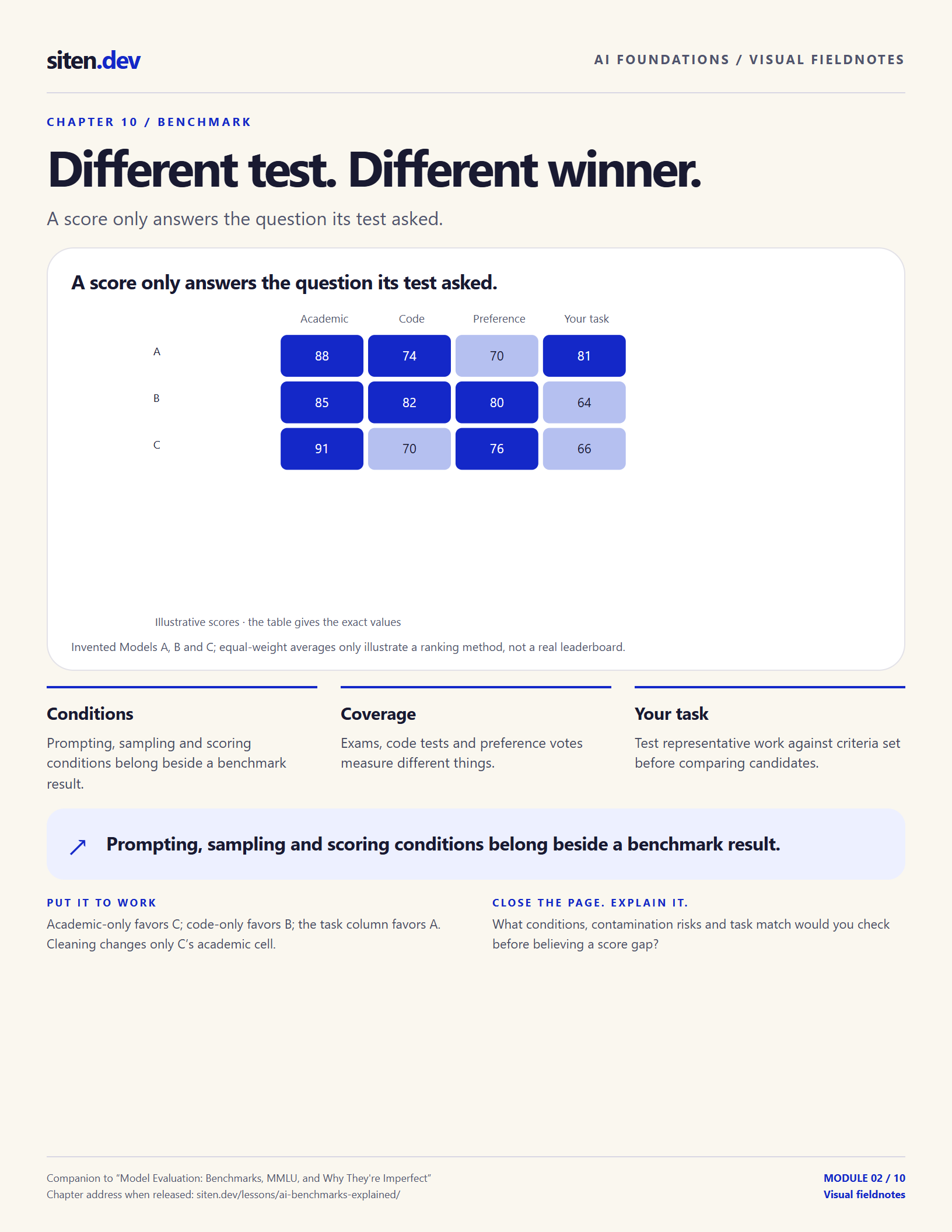
This exhibit uses invented scores for three made-up models. Change which columns count, then use the switch to remove the leaked questions.
EXHIBIT 10 / BENCHMARK
Explore the mechanismDifferent test. Different winner.
A score only answers the question its test asked.
Illustrative leader: Model A
Equal-weight averages over selected columns. Cleaning is off. All scores are invented.
Inspect the example data and reasoning
| Candidate | Selected-column mean |
|---|---|
| A | 78.25 |
| B | 77.75 |
| C | 75.75 |
Invented Models A, B and C; equal-weight averages only illustrate a ranking method, not a real leaderboard.
Read the mechanism without interacting
- Conditions
- Prompting, sampling and scoring conditions belong beside a benchmark result.
- Coverage
- Exams, code tests and preference votes measure different things.
- Your task
- Test representative work against criteria set before comparing candidates.
Academic-only favors C; code-only favors B; the task column favors A. Cleaning changes only C’s academic cell.
Try explaining it: What conditions, contamination risks and task match would you check before believing a score gap?
Count only the academic column and Model C leads; remove its leaked questions and Model A takes over, with C last. Count only code or only preference votes and Model B leads. Count only your own task and A leads. With every column counted, the leaked questions do not change the leader. No column is the answer; the right one depends on what you need.
How to read benchmark claims
When you see benchmark numbers in a model announcement:
- Name the test. An MMLU percentage and an Arena ranking measure different things. Neither is how good the model is overall.
- Find the conditions. Look for the number of examples, whether reasoning chains or repeated sampling were used, and whether the comparison table uses the same method for every model. If it does not, the numbers are not directly comparable.
- Look for contamination checks. A described method and its limits is easier to trust than silence, though silence proves nothing.
- Check the headroom. A top score near the ceiling cannot separate close models, and some answer keys are wrong.
- Note who ran it. A vendor's own table is a claim, not an independent result.
- Shortlist with scores, decide with your own test. Scores are a reasonable way to narrow candidates, not to make the final choice. Take 10 to 20 real prompts, score both models against criteria you wrote in advance, and compare. Hide which model wrote which answer if you can. A test this small can expose big gaps, not settle close calls. Evaluating AI Outputs shows how to do this properly for a live system.
The takeaway
A benchmark score reports how one model did on one test under particular conditions. MMLU is a useful, broad check of multiple-choice academic knowledge, but by 2024 its top scores were crowded, some answer keys were wrong, and its numbers depend on how the test is run. Leakage can inflate a score by a measurable but variable amount. Human preference rankings are closer to chat quality but have their own biases. Read the conditions behind a number, compare like with like, and test candidates on your own tasks.
Related lessons
- Evaluating AI Outputs: How to Know If Your System Is Working → — This lesson covers lab-style benchmarks; that one covers building tests for your own deployed system.
- Inference: How a Model Generates a Response → — Sampling and generation settings are one reason the same model can post different scores.
- The AI Ecosystem: Anthropic, OpenAI, Google, Meta — Who Does What and Why → — A method for comparing AI vendors on access, licence, data handling, pricing and retirement. For judging their benchmark claims, use this lesson.
Up next
Prompt Engineering: A Systems Thinker's Framework →
You now understand how models are built, trained, and evaluated. Module 3 starts with a practical skill: prompt engineering, giving AI systems instructions that steer a model toward useful outputs, and testing them.
VISUAL FIELDNOTES / 10
Keep the big picture.
A one-page visual companion. Save it, print it, or explain it to someone else.
 View the full-size sheet ↗
Different test. Different winner.
A score only answers the question its test asked.
One US Letter page · Vector artwork · Fits A4 when printed to fit
Read the key points as text
- Conditions
- Prompting, sampling and scoring conditions belong beside a benchmark result.
- Coverage
- Exams, code tests and preference votes measure different things.
- Your task
- Test representative work against criteria set before comparing candidates.
Remember: Prompting, sampling and scoring conditions belong beside a benchmark result.
Try it: Academic-only favors C; code-only favors B; the task column favors A. Cleaning changes only C’s academic cell.
Recall: What conditions, contamination risks and task match would you check before believing a score gap?
OPTIONAL CHECK
Check your understanding.
The optional check requires JavaScript. You can continue reading the lesson.
An announcement says 'Model X scores 88% on MMLU.' Which reading is most accurate?
A model scores 90% on MMLU, and the benchmark authors estimated expert-level accuracy at about 89.8%. Which conclusion is NOT justified?
Two models score 93% and 94% on a benchmark where most strong models score above 90%. What is the best conclusion?
A model scores about 8% lower on a new set of problems matched in style and difficulty to a public benchmark. What does this most plausibly suggest?
Lab A reports 90% on a benchmark using 32 sampled reasoning chains and a consensus rule. Lab B reports 86% using a direct answer after five examples. How should you treat the comparison?
Your team will use a model to draft customer replies. Model X leads Model Y by six points on MMLU. What is the best next step?
Which statement about Chatbot Arena-style human preference rankings is best supported?
MT-Bench has a strong language model grade other models' answers. Which concern applies to this setup?
Why can a popular benchmark become less informative about general ability over time?
A report says a model achieved 60% pass@10 on HumanEval. What does that mean?
Quiz complete
YOUR LEARNING
Keep your place.
Your progress is saved on this device.