MODULE 1 · LESSON 1 · 12 MIN
What Is AI? A Systems Thinker's Guide
By Siten Sanghvi · Published · Updated
When someone says “we're adding AI,” the useful follow-up is: what will it actually do?
A system that flags an invoice, one that drafts a reply, and one that sends a payment need different checks. Calling all three AI tells you very little about how they work or what you should trust them to do.
By the end of this lesson, you will be able to separate three things in an AI product: how its behavior is built, what it produces, and what it is allowed to do.
A useful definition, without pretending there is only one
An AI system uses inputs to infer outputs such as predictions, content, recommendations, or decisions. Its purpose and the environment it affects matter as much as the model inside it. This is a plain-language summary of the OECD's updated definition, not a claim that every program with an if-statement is AI.
The boundary is debated. For this course, the useful move is to name the mechanism instead of arguing over the label.
Replace the family ladder with three lenses
Some relationships really are nested: deep learning is a kind of machine learning. Other labels answer different questions.
| Lens | The question to ask | Examples |
|---|---|---|
| Method | How is the behavior built? | Written rules; machine learning; deep learning within ML |
| Output | What does it produce? | A score, a category, a recommendation, or generated content |
| Application | What can the surrounding system do? | Read an authorized record, propose a change, or execute an approved action |
A deep neural language model can be both ML and generative. A deep image classifier can use ML without generating content. A rule-based agent can act without an LLM. These are overlapping descriptions, not five rungs of a universal ladder.
EXHIBIT 01 / INFOGRAPHIC
Explore the building blocksWhat is doing the work?
Pick a building block to inspect its mechanism, a familiar example, and its limits. These selectors are not steps in a hierarchy.
An explicit condition tells the software what to do.
A tax eligibility rule; an appointment reminder.
- What it adds
- Behavior you can inspect directly.
- What to check
- A new situation often needs another rule.
These are overlapping building blocks. Deep learning is part of machine learning; generation describes an output, and tool use describes what an application does.
Read the five building blocks
- Rules. An explicit condition tells the software what to do. A tax eligibility rule; an appointment reminder. A new situation often needs another rule.
- Machine learning. The system learns patterns from data and applies them to new input. A demand forecast; a spam classifier. Performance can change when the incoming data changes.
- Deep learning. A neural network with multiple layers learns representations from data. Image recognition; speech recognition. A useful prediction still needs representative evaluation.
- Generative AI. A model produces content, such as a draft answer. A proposed email reply; an image generated from a description. A convincing output can contain a factual error.
- Tool-using systems. The application can use tools and decide what to do with their results. A support workflow looking up an order; a scheduling assistant proposing a meeting. The application must enforce permissions and approval for consequential actions.
Written rules and learned patterns
Imagine an invoice workflow. A rule can flag any total above a configured approval limit. Someone writes the condition; changing the limit changes the behavior directly. That is ordinary rule-based automation, whether or not the product's marketing calls it AI.
A learned classifier could instead suggest an expense category from past examples. The behavior comes partly from fitted parameters, the model's adjustable numerical settings. It needs evaluation on invoices it did not train on. “It learned from data” does not mean it keeps learning automatically after deployment.
Labeled examples are one way to train. Other learning setups find patterns without those labels or use other learning signals. We will unpack the differences later; do not make “every example has a human-written label” part of your definition of ML.
Deep learning and generation describe different things
Deep learning uses multilayer neural networks to learn representations. That tells you something about the method. Generating a proposed email reply tells you about the output task.
Many familiar generators use deep learning, but generative modeling is broader than neural networks. For example, a finite mixture model can describe a distribution from which new values are sampled without being a deep network.
This distinction pays off in design discussions. “We need a useful generated explanation” is a requirement. “We must use the largest deep model” is a proposed implementation that still needs justification.
Acting is a separate responsibility
An agent observes information and selects actions in an environment. The agent framework in Artificial Intelligence: A Modern Approach includes simple rule-based agents, not just language-model systems.
In the invoice example, drafting a reply and sending money are separate capabilities. A surrounding application may connect a model to tools, but it should enforce which records can be read, which actions need approval, and when the workflow stops. A model's suggestion does not grant permission.
Try the three-lens check
Take one tool you already use. Write three sentences:
- Method: What is written logic, what is learned, and what is unknown?
- Output: Does it predict, classify, generate, or combine tasks?
- Action: What can it actually change, and who authorizes that change?
“Unknown” is a useful answer. It tells you what to ask a vendor or developer. In our invoice workflow, rules check totals, a classifier suggests a category, a generator drafts a reply, and a controlled tool sends it only when authorized.
The takeaway
Separate method, output and action. Deep learning belongs within ML; generation describes what is produced; an agent describes a system acting in an environment. Start with the job, then choose the smallest system that can do it well.
Related lessons
- Machine Learning vs. Deep Learning vs. Generative AI compares learning methods and output tasks using one support-desk example.
- How Neural Networks Actually Work (Without the Math) opens the mechanism inside a neural model.
Up next
Machine Learning vs. Deep Learning vs. Generative AI: choose between a prediction, recognition and generation task without mistaking them for three exclusive technologies.
VISUAL FIELDNOTES / 01
Keep the big picture.
A one-page visual companion. Save it, print it, or explain it to someone else.
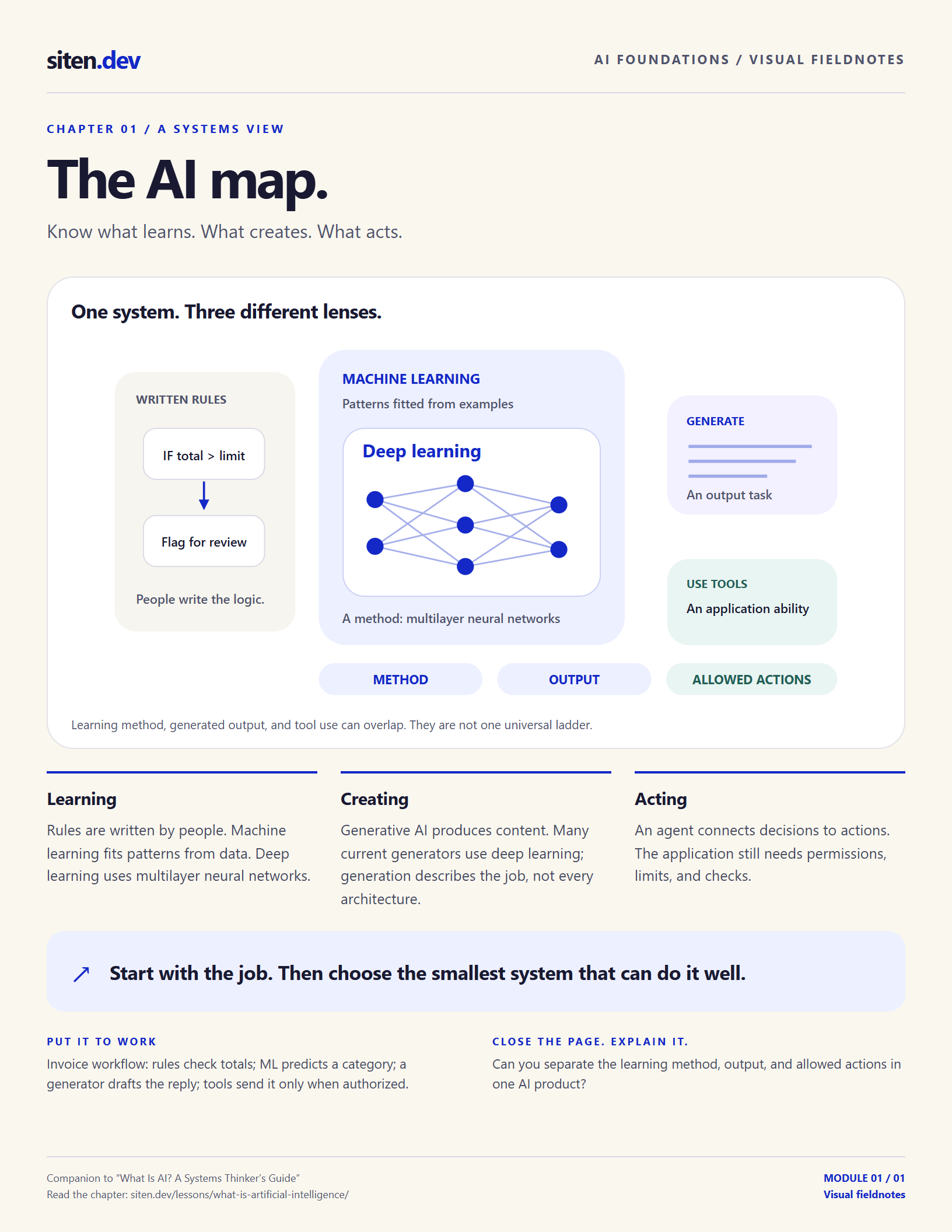 View the full-size sheet ↗
The AI map.
Know what learns. What creates. What acts.
One US Letter page · Vector artwork · Fits A4 when printed to fit
Read the key points as text
- Learning
- Rules are written by people. Machine learning fits patterns from data. Deep learning uses multilayer neural networks.
- Creating
- Generative AI produces content. Many current generators use deep learning; generation describes the job, not every architecture.
- Acting
- An agent connects decisions to actions. The application still needs permissions, limits, and checks.
Remember: Start with the job. Then choose the smallest system that can do it well.
Try it: Invoice workflow: rules check totals; ML predicts a category; a generator drafts the reply; tools send it only when authorized.
Recall: Can you separate the learning method, output, and allowed actions in one AI product?
OPTIONAL CHECK
Check your understanding.
The optional check requires JavaScript. You can continue reading the lesson.
Which description is most useful when evaluating an AI product?
Which relationship is valid?
A fixed invoice rule flags totals above an approval limit. What determines its behavior?
An expense classifier is trained once and deployed. Which assumption needs evidence?
A deep image classifier returns damaged or intact. How should you describe it?
A rule-based program observes a situation and chooses an action. Must it contain an LLM to fit the broad agent framework?
Which statement about generative modeling is appropriately scoped?
A model drafts an invoice reply. What authorizes the application to send it?
You do not know which model a vendor uses. What is a useful next step?
A proposed reply contains an incorrect payment amount. Which check matters before use?
Quiz complete
YOUR LEARNING
Keep your place.
Your progress is saved on this device.