MODULE 5 · LESSON 24 · 12 MIN
The AI Ecosystem: Anthropic, OpenAI, Google, Meta — Who Does What and Why
By Siten Sanghvi · Published · Updated
To compare AI vendors, read each one's own documents and ask the same six questions: how do I reach the model, what does the licence let me do, where does my data go, how is it priced, how long will the model stay available, and what shows it works on my task? The answers differ by vendor, plan and route and change within months, so this lesson teaches the questions, with examples dated 2026-11-11, and ranks no one.
"Who does what" is answerable from public documents: what each vendor sells, how, and under which terms. "Why" mostly is not, because motives are rarely stated in a form you can check, so this lesson sticks to what is written down.
Four roles, often held by different parties
Four jobs sit between a model's training and a user's answer, and one organization can hold several.
- Developer: trains the model and sets the licence or terms for using it.
- Host: runs inference (the model generating output; see Inference: How a Model Generates a Response) and so handles your prompts.
- Application builder: assembles context, enforces permissions and calls the model.
- Evaluator: checks whether the outcome is good enough for the task (BT-L19).
The same model can reach you by different routes. Anthropic's models overview lists Claude IDs for Anthropic's own API, Amazon Bedrock, Google Cloud and Microsoft Foundry, and says Amazon Bedrock and Google's managed service set their own retirement dates, while Foundry follows Anthropic's schedule. Microsoft's model catalogue lists OpenAI GPT models sold through Azure. Which party hosts, and whose terms apply, depends on the route you choose.
EXHIBIT 24 / ECOSYSTEM
Explore the mechanismMap the role, not the hype.
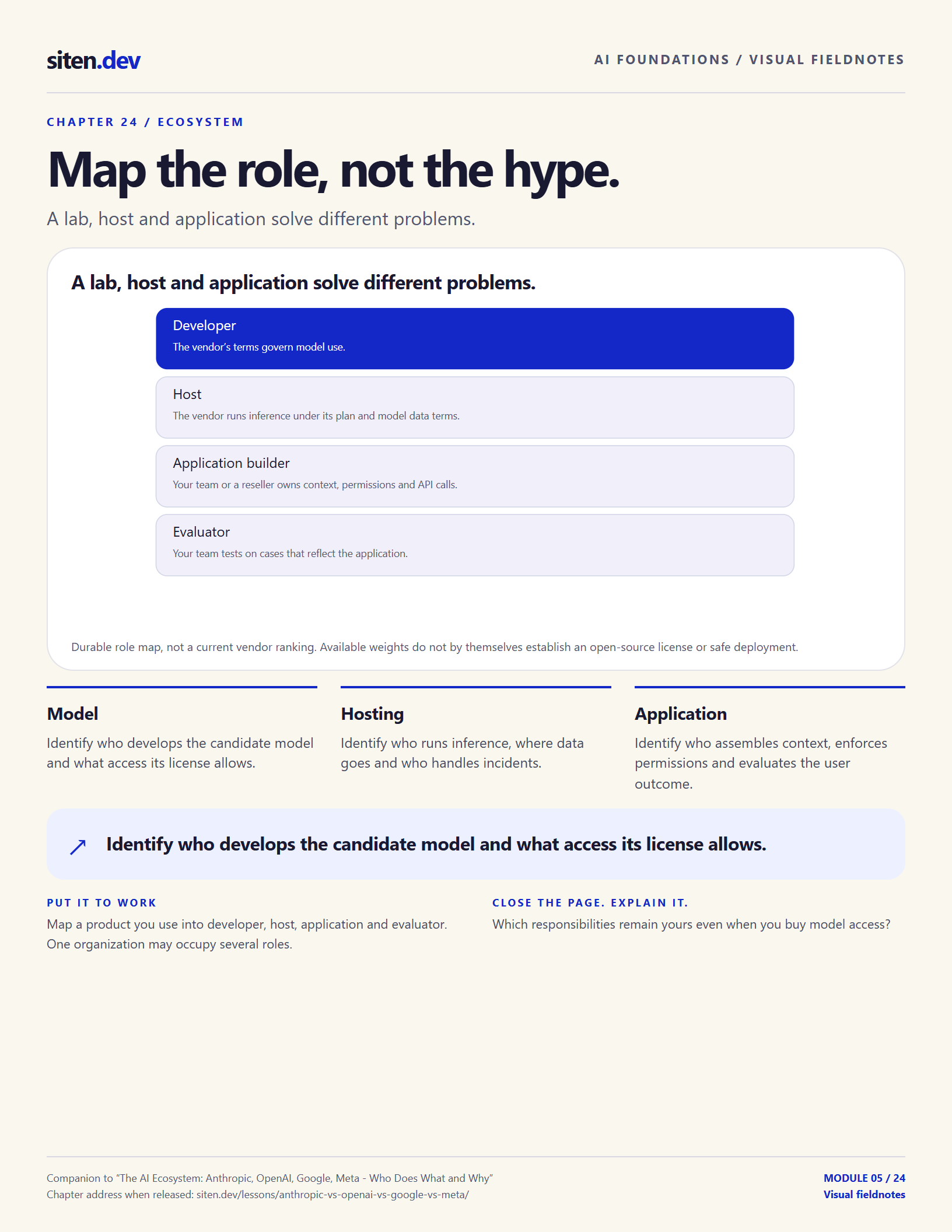
A lab, host and application solve different problems.
Developer: identify the owner
One organization can fill several roles. Check the terms for the exact service and route.
Inspect the example data and reasoning
| Element | What to notice |
|---|---|
| Developer | The vendor’s terms govern model use. |
| Host | The vendor runs inference under its plan and model data terms. |
| Application builder | Your team or a reseller owns context, permissions and API calls. |
| Evaluator | Your team tests on cases that reflect the application. |
Durable role map, not a current vendor ranking. Available weights do not by themselves establish an open-source license or safe deployment.
Read the mechanism without interacting
- Model
- Identify who develops the candidate model and what access its license allows.
- Hosting
- Identify who runs inference, where data goes and who handles incidents.
- Application
- Identify who assembles context, enforces permissions and evaluates the user outcome.
Map a product you use into developer, host, application and evaluator. One organization may occupy several roles.
Try explaining it: Which responsibilities remain yours even when you buy model access?
A dated snapshot: what four vendors sell
As named on each vendor's own page, 2026-11-11. Names will change.
| Vendor | Hosted models named on its page | Open-weight releases and licence (as read) |
|---|---|---|
| Anthropic | Claude Fable 5.2, Opus 5.5, Sonnet 5.5, Haiku 5.5, via Anthropic's API and the clouds above | None named on that page |
| OpenAI | GPT-6 Astra, GPT-6.1 Sol, GPT-6.1 Terra, GPT-6 Luna, via OpenAI's API; GPT models are also sold through Azure | gpt-oss: Apache-2.0 on its model card (2025) |
| Gemini 4 Carbon, Gemini 4 Argon, Gemini 3.x Flash and others via the Gemini API | Gemma 4: Apache-2.0, announced 2026-04-02 | |
| Meta | Muse Spark 1.3 and other Muse models via the Meta Model API | Muse Glimmer (2026-08-10): Apache-2.0. Muse Spark Open (2026-10-15): Muse Model License. Llama 4: Llama 4 Community License |
Reputation misleads: Meta's pages show a hosted API as well as several open-weight releases, and Google ships hosted Gemini and open Gemma. Meta's evidence here is thinner than the others': I found no retention or retirement terms for its hosted API, so some of its cells say so.
Open weights are not one licence, and not open source
Weights are the learned numbers inside a model that training sets (BT-L07 shows how training stages change them). An open-weight release lets you download them, under a licence that sets the rules. The Open Source Initiative's Open Source AI Definition (version 1.0) asks for more: freedom to use, study, modify and share, with weights, enough information about training data, and training and running code, all under OSI-approved terms. The Gemma 4 and Muse Glimmer posts above describe weights under Apache-2.0 and do not say training data or code are released, so "open-weight" is the safe label unless you check. Meta's Glimmer post says it is open sourcing the weights; by the OSI definition weights alone are not enough.
| Licence (read 2026-11-11) | What the text says that matters |
|---|---|
| Apache-2.0 (the licence text) | Includes a patent grant; withholds trademark rights; no field-of-use limit, no user or revenue threshold, no acceptable-use policy |
| Llama 4 Community License | A licensee whose products had over 700 million monthly users when Llama 4 was released must request a licence from Meta; "Built with Llama" notice; a distributed model built with Llama or its outputs must be named starting "Llama"; Acceptable Use Policy incorporated; no general trademark licence (only the name "Llama" for its naming duty) |
| Muse Model License | Free to use, modify and distribute; offering the model to others as an API service means notifying Meta and signing a separate agreement once gross revenue passes $20 million in 12 months (internal use and your own product's features are excluded); "Built with Muse Spark Open" notice; Usage Policy bars uses such as critical-infrastructure operation |
| Gemma Terms of Use (not used for Gemma 4) | Use restrictions must be passed to anyone you distribute to; Google reserves the right to restrict use "remotely or otherwise" |
Apache-2.0 has no use policy, but a publisher can ship one beside it: Muse Glimmer's model card links a Meta Usage Policy and says the model is not intended for people under 18. So "Apache-2.0" does not by itself answer "can I use it for anything?"; read the model card as well as the licence.
Downloadable does not mean runnable: Meta lists Muse Spark Open at 816 billion parameters, and its model card lists at least 700 GB of GPU memory even at reduced precision. Holding downloaded weights makes you the host, not the developer: the publisher's licence still applies. Self-hosting means you run it: BT-L16 covers what that costs, and BT-L21 the choice of using a model as-is, adding retrieval or fine-tuning. This reads the licences; it is not legal advice.
Data handling depends on vendor, plan, model and route
A data processor handles your data on your behalf under a contract; zero data retention (ZDR) means the vendor stores nothing after returning the response. Dated examples from each vendor's developer-API pages (chat apps and business plans have separate terms):
- OpenAI: API data is not used for training unless you opt in; abuse-monitoring logs are kept up to 30 days by default; zero data retention needs approval.
- Anthropic: retained data is never used for training without permission. It has no single stated default: its commercial retention page says API inputs and outputs are deleted within 30 days, with exceptions, while its API docs say conversation content is not retained by default except for Covered Models (Fable 5.x and the limited-availability Mythos 5.x), which require 30 days. Confirm for your account. ZDR is per organization and feature-dependent. On Amazon Bedrock and Google's managed Claude service the cloud provider, not Anthropic, is the processor.
- Google: under the Gemini API terms, unpaid services may use your content to improve products, human reviewers may read it, and the terms warn against submitting sensitive data; paid services do not use it for that, though prompts are logged for a limited time to detect abuse. In the European Economic Area (EEA), Switzerland and the UK the paid terms apply to every service.
- Self-hosted open weights: prompts stay on your hardware, so securing them is your job.
- Meta's hosted API: Meta's model page lists muse-spark-1.3 as "Not used to improve our products" and the cheaper muse-spark-1.3-contributor as "Used to improve our products". I found no retention terms; read them before use.
Governance and contracts belong to BT-L22: vendor assessment and which data may go to which tool.
Retirement: how long will the model exist?
Hosted models are retired, and the notice you get is a vendor choice.
| Vendor | Stated policy (read 2026-11-11) | A dated example |
|---|---|---|
| Anthropic | At least 60 days' notice for publicly released models on platforms Anthropic operates; the overview lists "not sooner than" dates | Claude Sonnet 4.5 notified 2026-09-30, retiring 2026-11-30: 61 days |
| OpenAI | Minimum notice: 6 months for generally available models, 3 for specialized variants, as little as 2 weeks for previews, all unless safety or compliance require faster action | GPT-4o, GPT-4.1 and mini snapshots (a snapshot is a dated version that stays fixed) notified 2026-10-14, removal 2027-01-14: about 3 months, and the page does not say which category applies. An entry for older snapshots including GPT-4o, 2026-04-22 to 2026-10-23, gave about 6 months |
| No fixed period; listed dates are "earliest possible" with advance notice | gemini-2.5-pro and gemini-2.5-flash route to newer models on 2026-12-01 | |
| Meta | Not stated for the hosted API; weights you hold have no vendor retirement date, but the licence still binds you | Not applicable |
Arithmetic check: 30 September to 30 November is 31 days (to 31 October) plus 30 more, so 61. Compare a stated policy with the dated entries, ask the vendor when they differ, and keep your own test cases (BT-L19) to check a replacement quickly.
Risk-management documents carry dates too: Anthropic's Responsible Scaling Policy (3.4, effective 2026-07-08), Google DeepMind's Frontier Safety Framework (3.1, 2026-04-17), Meta's Advanced AI Scaling Framework (post dated 2026-04-08) and OpenAI's Preparedness Framework (the version I could open: version 2, 2025-04-15; a newer one may exist). A date shows revision, not compliance.
Evidence of quality: test it on your task
A vendor's benchmark table is its own claim under stated conditions, and a human-preference leaderboard measures what its voters liked. BT-L10 explains why a vendor's table is a claim and a preference ranking is not shown to be harder to game; no score appears here. Shortlist with rankings, then test on your own cases with BT-L19's method. "Which model is best?" has no answer until you say for what.
Try it: a vendor worksheet
Pick one real use case and two candidate vendors. Fill one cell per question below with a fact, its source URL and the date you read it.
| Question | Where to look | Vendor A | Vendor B |
|---|---|---|---|
| Route: who hosts, and via which platform? | Models page, cloud catalogue | ||
| Licence or terms: what may I do, and are there thresholds or usage rules? | Licence text, terms of service | ||
| Data: training use, retention, processor, region, any cheaper tier that trades your data? | Data-retention and terms pages | ||
| Pricing structure: per token, batch, reserved capacity? | Pricing page (BT-L16) | ||
| Retirement: stated notice, and dates for the model you would use? | Deprecations page | ||
| Evidence: how did it do on my own cases, and is any gap bigger than noise (BT-L19)? | Your test |
Self-check: a cell with no URL and no date is a guess. Re-read the pages when you decide, and again when the vendor announces a change.
The takeaway
To compare AI vendors, ask the same six questions of each one's own documents: route, licence, data handling, pricing structure, retirement and your own test. As of 2026-11-11 the answers differ by vendor and by route, "open-weight" covers at least three different licences and is not the same as open source, and the stated notice before a hosted model retires runs from 60 days (Anthropic) to six months for some OpenAI models, while Google states no fixed period. Treat every cell as a dated source, not a ranking.
Related lessons
- Model Evaluation: Benchmarks, MMLU, and Why They're Imperfect covers why vendor tables and leaderboards need checking.
- AI Infrastructure: APIs, Hosting, and Cost Models covers hosting options, pricing structure and dated data-handling examples.
- AI Governance, Compliance, and Enterprise Policy covers vendor assessment and data rules.
Up next
Capstone: Design a Complete AI System from Scratch: its design template's Data boundary part asks where each data type is processed and for the deployment option chosen and one rejected, which this lesson's route, licence and data questions feed.
VISUAL FIELDNOTES / 24
Keep the big picture.
A one-page visual companion. Save it, print it, or explain it to someone else.
 View the full-size sheet ↗
Map the role, not the hype.
A lab, host and application solve different problems.
One US Letter page · Vector artwork · Fits A4 when printed to fit
Read the key points as text
- Model
- Identify who develops the candidate model and what access its license allows.
- Hosting
- Identify who runs inference, where data goes and who handles incidents.
- Application
- Identify who assembles context, enforces permissions and evaluates the user outcome.
Remember: Identify who develops the candidate model and what access its license allows.
Try it: Map a product you use into developer, host, application and evaluator. One organization may occupy several roles.
Recall: Which responsibilities remain yours even when you buy model access?
OPTIONAL CHECK
Check your understanding.
The optional check requires JavaScript. You can continue reading the lesson.
A company reaches a Claude model through Amazon Bedrock, not Anthropic's own API. Per Anthropic's documentation read for this lesson, what should it do?
A vendor says its model is "open-weight" under Apache-2.0. Which statement about the Open Source AI Definition (version 1.0) is accurate?
A company with $50 million in gross annual revenue wants to sell API access to a model under the Muse Model License, as read on 2026-11-11. What does the text require?
Which feature appears in the Llama 4 Community License but not in Apache-2.0, as read in this lesson?
A vendor promises at least 60 days' notice and announces on 30 September that a model retires on 30 November. What follows?
A deprecations page lists minimum notice by model category. A new entry gives about three months for snapshots, and the page does not say which category applies. What is the best next step?
Outside the EEA, Switzerland and the UK, a team prototypes on an unpaid Gemini API key using real customer support tickets. What is the main concern, per Google's terms as read for this lesson?
A model announcement says it "ranks first" on a public human-preference leaderboard. How should this affect a vendor decision?
A worksheet cell says "Vendor B does not train on our data." Which evidence makes that cell trustworthy?
A bank downloads Apache-2.0 open weights, runs them on its own servers, builds an app on them and tests its answers. Which roles does the bank hold?
Quiz complete
YOUR LEARNING
Keep your place.
Your progress is saved on this device.