MODULE 1 · LESSON 3 · 14 MIN
How Neural Networks Actually Work (Without the Math)
By Siten Sanghvi · Published · Updated
A neural network transforms numerical inputs through connected calculations. Training adjusts its parameters to improve a chosen objective. You can understand that distinction before learning calculus.
The circles-and-arrows drawing becomes useful once you can answer two questions: what happens when a signal moves forward, and what changes when the network learns?
One node: combine, then transform
In the simple feed-forward network used here, a node combines weighted inputs, adds a bias, and applies an activation function. A weight controls an input's contribution, including its sign. The bias shifts the combined value before the activation.
An activation is not always an on/off decision. A ReLU keeps positive values and returns zero for negative ones. A sigmoid maps a value to a score between zero and one. Different layers and architectures use different operations.
The feed-forward networks chapter describes this computational view. The biological-neuron analogy is not needed to trace it.
Follow the signal through a small network
Our interactive example has two inputs, two hidden units and one output. The inputs are handpicked features called promotional language and unfamiliar sender. The weights and biases are handpicked too: this is a toy calculation, not a trained spam detector.
The hidden units use ReLU. The output uses sigmoid. At the default settings, the hidden values are 0.48 and 0, and the rounded output is 48%. Change the first input-to-hidden weight from 0.8 to 2.0 and the first hidden value becomes 1.44; the output rounds to 65%.
That percentage is a demonstration score. It is not a measured probability that an email is spam, or a guarantee the decision is correct.
EXHIBIT 03 / NETWORK
Change a weight. Follow the result.A connection changes the prediction.
Two input signals enter this tiny network. Pick a connection and change its weight to see what happens downstream.
Change a weight to recompute the hidden values and output.
See the calculation
Hidden nodes use max(0, weighted sum + bias). The output applies a sigmoid, 1 / (1 + exp(−z)). Biases are −0.2, −0.1, and −0.4.
Solid connections have positive weights; dashed connections have negative weights. This is a toy network with handpicked weights. Its score is an arithmetic illustration, not a trained spam detector or a calibrated risk estimate.
Read how the signal moves
- Two numerical inputs represent features of a message.
- Each connection multiplies an input by its weight. The hidden nodes add those contributions and a bias, then apply an activation.
- The output combines the hidden values. Changing an upstream weight can change the result, while a zero activation can stop a signal.
Training has four distinct jobs
Suppose you are building a defect detector using labeled photos. This is one supervised example, not the only way to train a network.
1. Make a prediction
Run a forward pass on a training example. The output is compared with its target through a loss function, a numerical objective that scores how well this prediction fits the training task.
2. Measure the loss
Loss provides the quantity the optimizer tries to reduce. A lower loss on training examples does not, by itself, establish useful performance on new photos.
3. Compute gradients with backpropagation
Gradients describe how the loss changes with the parameters. Backpropagation efficiently computes those derivatives through the network. It supplies information for learning; it is not itself the whole weight-update procedure.
4. Update parameters with an optimizer
An optimizer, such as gradient descent, uses the gradients to update weights and biases. The learning rate controls the scale of an update; it is not the actual update value. Training repeats this process. The optimization chapter separates the objective, gradient calculation and update method.
The distinction explains why moving the demo's slider is not training: no labeled dataset, loss calculation or optimizer chooses that movement. You are exploring a forward calculation.
More depth is an option, not a verdict
Several layers can learn compositions of features that are useful for a task. But depth alone does not guarantee that a network generalizes, that each layer has a tidy semantic role, or that a deeper model beats every wider or simpler model.
Architecture, optimization, data and evaluation all matter. For example, the original residual-network paper studied a specific architecture that made certain deeper image networks easier to optimize. That result is not permission to treat “more layers” as an unconditional design rule.
Keep some evidence out of training
For the defect detector, use separate data for training, model selection and final evaluation. Include representative defects and intact parts. Look at false alarms as well as missed damage.
If training performance improves while held-out performance worsens, suspect overfitting or a mismatch between the data and task. Regularization, data choices and architecture changes are options to evaluate, not guaranteed repairs. The model-validation guidance in scikit-learn explains why repeatedly tuning against the final test set weakens that evidence.
Try it: explain a changed score
Reset the exhibit. Increase the selected weight, then explain which hidden value changes and which stays at zero. Now describe what an actual training loop would have to add. If you can separate forward calculation, loss, gradient and update, the diagram is doing useful work.
The takeaway
A forward pass transforms inputs using the current weights, biases and activations. Training adds loss measurement, gradient calculation and optimizer updates. Lower training loss does not guarantee better performance on new data.
Related lessons
- What Is a Large Language Model? connects neural parameters to a language-generation task.
- The Transformer Architecture Explained introduces a particular family of network designs.
- Tokens, Embeddings, and Context Windows Explained explains how text becomes numerical input.
Up next
What Is a Large Language Model?: follow a text-generating model's loop and separate its learned parameters from the surrounding application's tools and memory.
VISUAL FIELDNOTES / 03
Keep the big picture.
A one-page visual companion. Save it, print it, or explain it to someone else.
 View the full-size sheet ↗
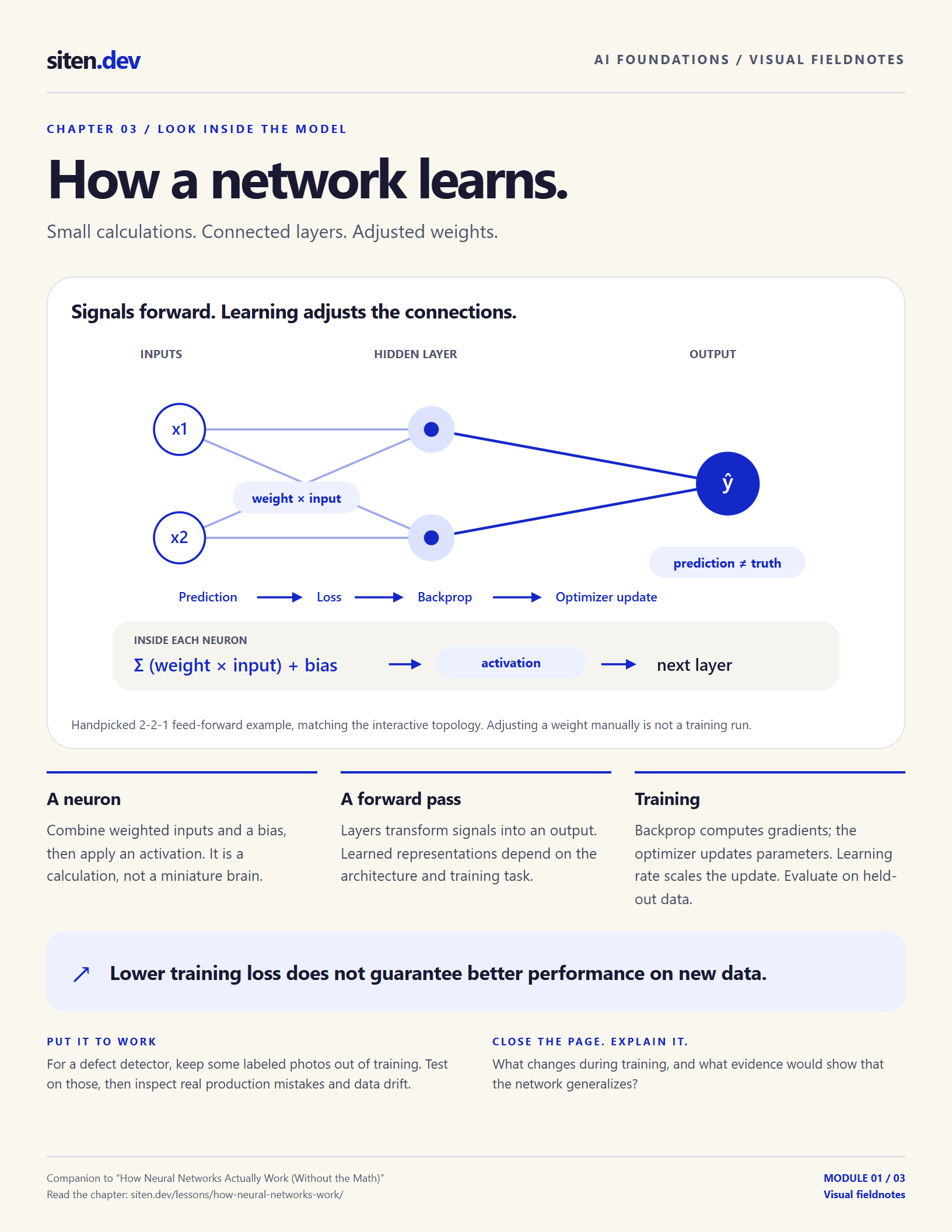
How a network learns.
Small calculations. Connected layers. Adjusted weights.
One US Letter page · Vector artwork · Fits A4 when printed to fit
Read the key points as text
- A neuron
- Combine weighted inputs and a bias, then apply an activation. It is a calculation, not a miniature brain.
- A forward pass
- Layers transform signals into an output. Learned representations depend on the architecture and training task.
- Training
- Backprop computes gradients; the optimizer updates parameters. Learning rate scales the update. Evaluate on held-out data.
Remember: Lower training loss does not guarantee better performance on new data.
Try it: For a defect detector, keep some labeled photos out of training. Test on those, then inspect real production mistakes and data drift.
Recall: What changes during training, and what evidence would show that the network generalizes?
OPTIONAL CHECK
Check your understanding.
The optional check requires JavaScript. You can continue reading the lesson.
In this feed-forward example, what does a hidden node calculate?
What can a negative connection weight do in a weighted sum?
How does the ReLU used by the hidden units handle a negative combined value?
The demo output is 48%. What does this establish?
What is backpropagation responsible for in the described training loop?
What does a gradient-descent optimizer use the gradients to do?
Which description of learning rate is correct here?
You manually move a weight slider. Did the demo train on a labeled dataset?
Training loss falls but held-out performance worsens. What should you conclude?
Does a deeper network necessarily beat a wider or simpler alternative?
Quiz complete
YOUR LEARNING
Keep your place.
Your progress is saved on this device.