MODULE 1 · LESSON 2 · 13 MIN
Machine Learning vs. Deep Learning vs. Generative AI
By Siten Sanghvi · Published · Updated
Deep learning is a method within machine learning. Generative AI describes a content-producing task. The same model can fit all three labels.
That distinction matters when a team says “we need AI for customer support.” Predicting next week's ticket volume, recognizing a broken part in a photo, and drafting a response are three different jobs. Choosing a model before choosing the job makes the design harder to evaluate.
Machine learning: fit a pattern from examples
A forecasting model can use historical ticket counts and relevant features, such as day of the week, to estimate future demand. You can compare its prediction with the count that actually arrives.
That is a learning problem: use data and an objective to fit behavior. In supervised learning, examples include target answers. In unsupervised learning, the goal may be to find structure without those labels. The Machine Learning Basics chapter explains the distinction between fitting training data and generalizing to new cases.
For this support desk, begin with a simple baseline, such as last week's corresponding day. A more complicated model earns its place only if it improves the outcome you care about. No label promises that it will.
Deep learning: learn representations through layers
Now imagine customers uploading photos of damaged parts. A neural image classifier can learn representations that help distinguish damage from an intact item.
Multiple layers transform the input. In some image networks, early features resemble edges and textures; later features combine them into more task-relevant patterns. This is a useful example, not a guarantee that every network's layers have neat human-readable jobs. The representation-learning reference develops the underlying idea.
Deep learning does not remove every data or engineering decision. You still choose a training objective, data, preprocessing and evaluation. It does not always require hand-labeled examples: pretrained models and other training setups change what you must supply for a particular task.
A deep network may classify, predict or generate. It is not limited to recognition.
Generative AI: create a proposed output
The third job is drafting a reply to the customer. You want new text that uses the right policy and order details, rather than just a damage label.
Many familiar text generators are neural models. But “generative” is not shorthand for “the next layer after deep learning.” Non-deep probabilistic models can generate samples too; the Stan mixture-model guide gives a concrete example of such a model.
A generated response needs task-specific checks. Does it cite the applicable policy? Did it invent an order number? Does it promise a replacement the business has not authorized? Plausible content is an output to evaluate, not proof of correctness.
EXHIBIT 02 / ARCHITECTURE
Compare the mechanismsSame product. Different jobs and methods.
A shop can forecast demand, recognize a damaged package, or draft a reply. Select a job, then inspect what its model needs.
A forecasting model predicts the next week's order volume from structured features. A neural network is one possible approach, but it is not required.
- What it needs
- Examples and an objective for learning a pattern.
- What it does
- Fits a model that can predict, rank, or classify new inputs.
- Where to be careful
- Good performance on training examples does not establish performance on new cases.
These comparison rows are not a nested hierarchy. Deep learning is a subset of ML; generation describes a task, including approaches outside deep learning. Many deep networks classify rather than generate.
Read the model comparison
- Machine learning
- Examples and an objective for learning a pattern. Fits a model that can predict, rank, or classify new inputs. Good performance on training examples does not establish performance on new cases.
- Deep learning
- A neural network, training data, and a way to optimize its parameters. Learns representations through multiple layers. More layers alone do not establish a useful or reliable system.
- Modern generative models
- A generative model and a request or other conditioning input. Produces content such as text, images, or audio. Generating a plausible answer does not verify its factual claims.
Compare requirements, not marketing categories
| Question | Forecast ticket volume | Inspect a photo | Draft a response |
|---|---|---|---|
| Desired output | A number or interval | A damage label or score | Proposed text |
| One possible approach | A statistical or ML forecast | A deep image classifier | A neural language model with supplied evidence |
| Does it generate content? | Not in this example | Not in this example | Yes |
| Useful evaluation | Error against later observed counts | Missed damage and false alarms on held-out photos | Supported claims, policy compliance and useful responses |
These are design examples, not restrictions. A forecast could use a neural network; a multimodal generative model could help inspect an image. Data requirements and cost depend on the actual model and task, not a universal thousands/millions/billions rule.
Try it: name the output before the model
Pick a support task and finish this sentence: “A useful result would be ___, and I would check it by ___.”
For our three jobs, the checks are different. Forecasting needs later observed counts. Damage recognition needs representative labeled test photos. Drafting needs evidence that the reply says the right thing. One impressive demo cannot replace all three evaluations.
If you decide to compare models, give them the same task and representative cases. Include cases where they should fail safely, not only examples chosen to make the output look good. Do not assume that a generated explanation makes a prediction more accurate.
The takeaway
Choose the outcome first. Machine learning fits patterns; deep learning uses multilayer neural representations; generation creates a proposed output. These descriptions overlap. A polished generation is not a substitute for an accurate prediction.
Related lessons
- What Is AI? A Systems Thinker's Guide separates methods, outputs and allowed actions.
- How Neural Networks Actually Work (Without the Math) explains the calculations inside a neural model.
- Training Data: What Models Learn From and Why It Matters examines the examples and signals behind training.
Up next
How Neural Networks Actually Work (Without the Math): follow a signal through a small network, then separate calculating an output from learning its weights.
VISUAL FIELDNOTES / 02
Keep the big picture.
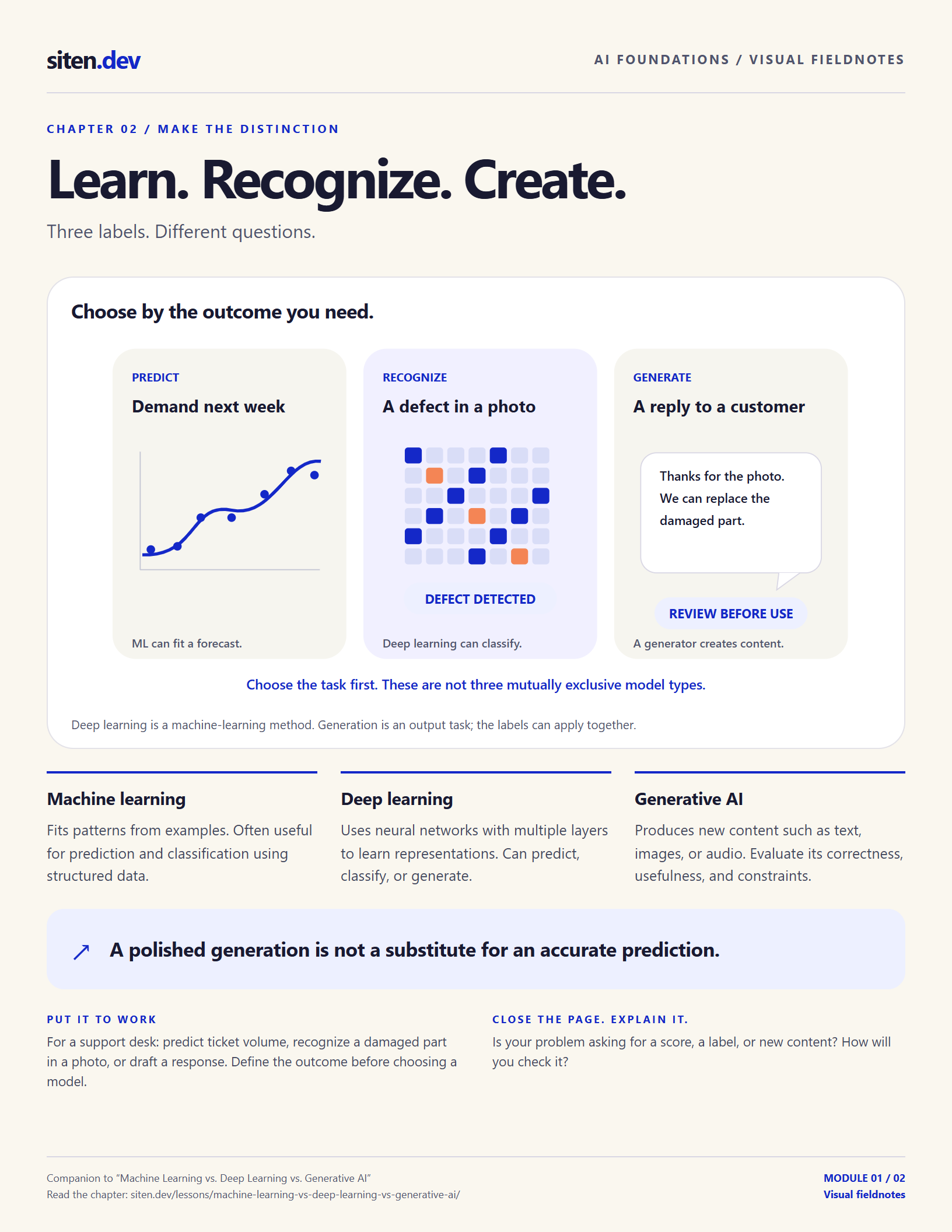
A one-page visual companion. Save it, print it, or explain it to someone else.
 View the full-size sheet ↗
Learn. Recognize. Create.
Three labels. Different questions.
One US Letter page · Vector artwork · Fits A4 when printed to fit
Read the key points as text
- Machine learning
- Fits patterns from examples. Often useful for prediction and classification using structured data.
- Deep learning
- Uses neural networks with multiple layers to learn representations. Can predict, classify, or generate.
- Generative AI
- Produces new content such as text, images, or audio. Evaluate its correctness, usefulness, and constraints.
Remember: A polished generation is not a substitute for an accurate prediction.
Try it: For a support desk: predict ticket volume, recognize a damaged part in a photo, or draft a response. Define the outcome before choosing a model.
Recall: Is your problem asking for a score, a label, or new content? How will you check it?
OPTIONAL CHECK
Check your understanding.
The optional check requires JavaScript. You can continue reading the lesson.
Which statement correctly relates the three labels?
Your desk needs an estimate of next week’s ticket count. What should you define first?
Does every machine-learning setup need human-labeled examples?
What is learned representation a useful description of?
A deep image classifier returns a damage score. Must it also be a content generator?
Which evaluation best fits the generated support reply?
What can a non-deep finite mixture model demonstrate?
Why compare a new forecasting model with a simple baseline?
Which data-size claim is justified without further information?
A model generates an explanation for its forecast. What follows?
Quiz complete
YOUR LEARNING
Keep your place.
Your progress is saved on this device.