MODULE 5 · LESSON 22 · 11 MIN
AI Governance, Compliance, and Enterprise Policy
By Siten Sanghvi · Published · Updated
AI governance is the set of written decisions an organization makes about who may use AI for what, with which data, under whose responsibility, and how problems get noticed and fixed. Compliance is narrower: meeting the specific laws and contracts that apply to a use. Governance is what lets you show you did. There is no single AI law or checklist; what applies depends on where you operate, who is affected and what the system does.
This lesson is general education, not legal advice. Each legal statement names its jurisdiction and was checked against the cited source on 2026-11-11 or 2026-11-12; where something could not be confirmed, the text says so. AI law is changing quickly, so ask qualified counsel what applies to you. A provider builds or sells an AI system; a deployer uses one under its own authority; PII is data about an identifiable person; a DPA is the contract under which a vendor processes personal data for you.
EXHIBIT 22 / GOVERNANCE
Explore the mechanismA decision needs an owner.
Make responsibilities and evidence visible before release.
0 / 4 planning records drafted
The illustrative tier describes impact before controls. This checklist does not assign a legal risk category, determine obligations or certify compliance.
Inspect the example data and reasoning
| Record | Addresses | Example owner | Does not establish |
|---|---|---|---|
| Accountable owner · Open | Who answers for the use | Business lead | Whether the use is lawful |
| Data boundary · Open | Which data classes go where | Data or privacy lead | What a vendor actually does |
| Evaluation evidence · Open | Whether the tool works on your cases | Product lead and independent reviewer | Fairness or legality |
| Oversight and incident plan · Open | Who reviews, escalates and switches it off | Operations or risk lead | Prevention of every incident |
Workflow illustration only. Not legal advice, a legal risk classification, certification or a declaration of compliance.
Read the mechanism without interacting
- Scope
- Document purpose, users, affected people and the data used.
- Evidence
- Assign owners for evaluation, oversight, change control and incident response.
- Review
- Determine applicable obligations with qualified reviewers for the actual use and jurisdiction.
Draft an owner, data boundary, evaluation plan and escalation route for one use. Empty fields are open work, not a compliance score.
Try explaining it: Who can stop the system, and what evidence will that person need?
What governance is for
- Limit harm. AI can produce wrong, biased or manipulated output and leak data; controls lower how likely and how severe that is. Technical controls are in AI Hallucinations, Prompt Injection, and Safety Guardrails Explained.
- Make accountability possible. When something fails, someone owns it, records (an audit trail; see Observability and Monitoring for AI Applications) exist and there is an escalation route.
- Scale. Written decisions mean the fifth use case does not restart the debate.
NIST's AI Risk Management Framework (AI RMF 1.0, January 2023) treats governance as a cross-cutting function beside Map, Measure and Manage. It is voluntary and says its actions are not a checklist.
The building blocks
- Inventory. Register each AI system: purpose, owner, data, decisions it informs. You cannot govern what you cannot see.
- Risk tiering. More review for uses that affect people's opportunities and are hard to reverse (see Try it).
- Acceptable use and data rules. Approved tools and plans, and which data classes may go to each.
- Evaluation. Test on your own cases, compared by segment or group where it matters (Evaluating AI Outputs: How to Know If Your System Is Working).
- Human review. Which outputs or decisions need a recorded person's check before action.
- Disclosure. When people must be told they face AI (partly a legal duty in the EU).
- Vendor assessment. Security, privacy terms, retention and data location. Build vs. Buy: Foundation Models, Fine-Tuning, or RAG? covers the build-or-buy choice.
- Incident response. Detection, escalation, who can switch the system off, help for affected people, fixes.
- Training. Staff know the limits and the rules.
The site's AI governance evidence checklist is a related worksheet with owner, evidence link and review date.
Which rules might apply: dated examples
EU: the AI Act (Regulation (EU) 2024/1689). It reaches providers placing AI on the EU market, deployers established or located in the EU, and non-EU providers or deployers whose output is used in the EU (Article 2(1)). The "Digital Omnibus on AI", Regulation (EU) 2026/1744, was adopted and has been in force since 27 July 2026; it is not merely proposed. Under the consolidated Article 113: the original bans and the AI-literacy duty (now a duty to take measures to support staff literacy) apply from 2 February 2025; two added bans (non-consensual intimate deepfakes and child sexual abuse material) from 2 December 2026; the Act generally, including transparency duties, from 2 August 2026 (some generators already on the market have until 2 December 2026, Article 111(4)); high-risk rules for the uses listed in Annex III (hiring, credit and similar, below) from 2 December 2027, previously 2 August 2026; and for AI in regulated products (Annex I) from 2 August 2028.
The Act sorts uses, not technologies. Article 5 bans some practices, such as social scoring and, except for medical or safety reasons, inferring emotions in workplaces and schools. Annex III lists high-risk areas, including recruitment and decisions on work terms, creditworthiness of individuals, and life and health insurance risk assessment and pricing (not insurance generally).
EU: GDPR (Regulation (EU) 2016/679). Where it applies, it covers personal data you put into an AI tool. Article 22(1) reads as a right not to be subject to a decision based solely on automated processing with legal or similarly significant effects, but the EU Court of Justice treats it as a prohibition in principle and held that a credit score is such a decision where a bank gives it a determining role (C-634/21, 7 December 2023, paras 50, 52 and 54). Exceptions are contract necessity, authorisation by law and explicit consent; for contract and consent the controller must provide at least human intervention, a chance to express a view and a way to contest (Article 22(3)). Whether a decision is "solely" automated is for counsel. A proposal to amend GDPR is still in negotiation; no adopted change was found (checked 2026-11-12).
US: a patchwork. No national statute across sectors was found, a negative finding not confirmed from a primary source; Congress and other states were not checked. EO 14110 (2023) was revoked on 20 January 2025 by EO 14148; EO 14365 (11 December 2025) directs agencies to challenge conflicting state AI laws and to propose legislation, but does not itself repeal a state law. Rules also move at state level. Colorado's SB 26-189, signed 14 May 2026, repeals and re-enacts its 2024 AI Act provisions as a law on automated decision-making technology in consequential decisions. Under its Section 5 the act generally takes effect 1 January 2027 (a few rulemaking provisions on signing) and applies to decisions made on or after that date; its developer documentation and deployer notice duties sit within it.
Data rules: classify before you paste
A data classification policy says which data may go to which tool. Illustrative:
| Class | Example | Rule of thumb |
|---|---|---|
| Public | Published docs | Any approved tool |
| Internal | Meeting notes | Approved business plans only |
| Confidential or personal | Customer tickets with names | Tools with a DPA and training and retention terms you checked |
| Regulated | Health or card data | Case-by-case approval with legal review |
Check the plan, not just the brand. Anthropic's training page (16 March 2026) says consumer chats may be used to improve models if the user allows it; OpenAI's API page says API data is not used for training unless you opt in, and that abuse-monitoring logs are kept up to 30 days by default, with exceptions. Not training is not the same as not keeping. Record the date you checked. Removing a name does not make data anonymous if it can still be tied to a person; Observability and Monitoring for AI Applications covers that and what to log.
Model risk management
Banks run model risk management (MRM): documenting, validating, monitoring and governing models that inform decisions. On 17 April 2026 the US bank supervisors (Fed, OCC, FDIC) issued revised guidance, sent out by the Fed as SR 26-2, superseding SR 11-7. Its text covers non-generative AI models and puts generative and agentic AI outside its scope, leaving their controls to the bank's own governance. Do not assume it covers an LLM assistant.
Fairness: measure by group
Averages hide group gaps. A 2018 audit found gender-classifier error rates up to 34.7% for darker-skinned women against at most 0.8% for lighter-skinned men; model cards propose per-group reporting.
For US employment selection, the federal Uniform Guidelines (29 CFR 1607.4(D)) say a race, sex or ethnic group's selection rate under four-fifths of the highest group's is generally regarded as evidence of adverse impact (screening out a group at a notably higher rate); smaller gaps can matter too. Example: 60 of 100 applicants selected in one group and 36 of 100 in another give 36 / 60 = 0.60, below 0.80. That prompts investigation; it does not settle whether discrimination occurred.
Try it: tier three uses, then write one page
This scoring is the course's own, not a legal test. Score each use 0 to 2 on four questions. Affected: staff only 0, customers 1, applicants or people seeking credit or services 2. Reversible: easily 0, with effort 1, hardly 2. Data: public 0, internal 1, personal or regulated 2. Unchecked action: a person approves 0, sometimes 1, never 2. Totals of 0 to 2 are Tier 1, 3 to 5 Tier 2, 6 to 8 Tier 3.
Worked example (invented uses):
| Use | Affected | Reversible | Data | Unchecked | Total | Tier |
|---|---|---|---|---|---|---|
| Summarize internal meeting notes | 0 | 0 | 1 | 0 | 1 | 1 |
| Draft support replies that agents approve | 1 | 1 | 2 | 0 | 4 | 2 |
| Rank applicants, auto-reject the bottom half | 2 | 2 | 2 | 2 | 8 | 3 |
Tier 3 means "send to legal and risk review", not a legal finding. For EU applicants the third use would likely sit in Annex III's recruitment area and could raise GDPR Article 22; counsel decides.
Now write a one-page AI use policy with these headings: purpose and scope; approved tools and plans; data classes and where each may go; human review; disclosure; vendor check and retention terms; incident owner and disable route; training; review date. Test it: could a new colleague, reading only the page, say which tool and data are allowed and whom to call?
The takeaway
AI governance is an organization's own written system: inventory, tiers that match care to impact, data rules by class and plan, human review, and an incident route with a named owner. Compliance is meeting the laws that apply, which are scoped and dated. As of 11-12 November 2026: the EU AI Act's Annex III high-risk rules apply from 2 December 2027 after a 2026 amendment; GDPR Article 22 restricts solely automated significant decisions in the EU; the US federal position is executive orders with no national statute found; Colorado has replaced its 2024 law, effective 1 January 2027. Check current law for your use with counsel.
Related lessons
- AI Hallucinations, Prompt Injection, and Safety Guardrails Explained: the technical controls a governance policy can require: guardrail layers and designing for a manipulable model.
- Observability and Monitoring for AI Applications: what to log, what not to log, and how long to keep it.
- Build vs. Buy: Foundation Models, Fine-Tuning, or RAG?: choosing prompting, retrieval, fine-tuning or hosting, including which of your data leaves with each choice.
Up next
Designing AI-First Architectures
Governance says who owns what and which data goes where. The next lesson walks through a reference architecture for an application built on a hosted model: context, routing, output checks, and the records and versioning around them.
VISUAL FIELDNOTES / 22
Keep the big picture.
A one-page visual companion. Save it, print it, or explain it to someone else.
 View the full-size sheet ↗
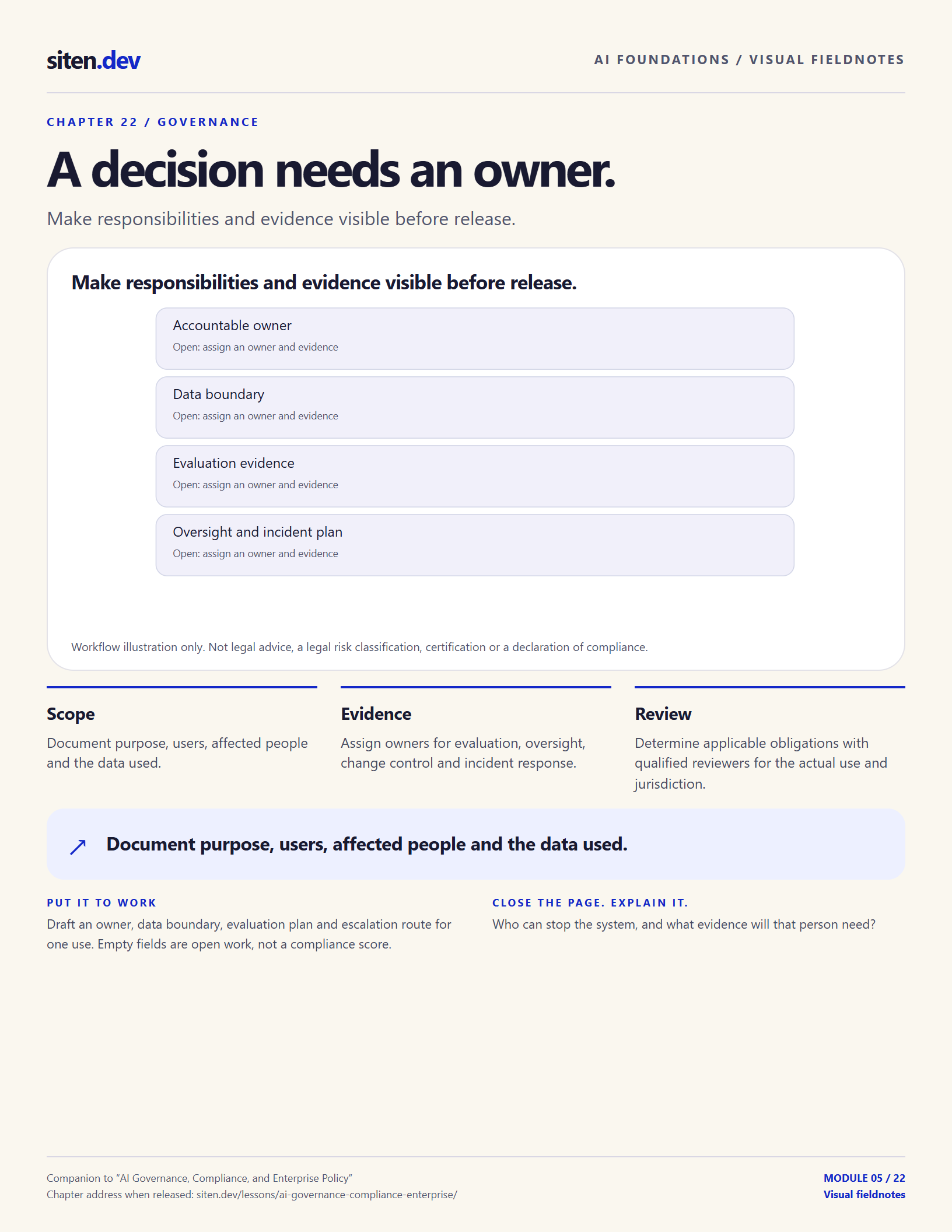
A decision needs an owner.
Make responsibilities and evidence visible before release.
One US Letter page · Vector artwork · Fits A4 when printed to fit
Read the key points as text
- Scope
- Document purpose, users, affected people and the data used.
- Evidence
- Assign owners for evaluation, oversight, change control and incident response.
- Review
- Determine applicable obligations with qualified reviewers for the actual use and jurisdiction.
Remember: Document purpose, users, affected people and the data used.
Try it: Draft an owner, data boundary, evaluation plan and escalation route for one use. Empty fields are open work, not a compliance score.
Recall: Who can stop the system, and what evidence will that person need?
OPTIONAL CHECK
Check your understanding.
The optional check requires JavaScript. You can continue reading the lesson.
A manager says, "We follow the EU AI Act, so our AI governance is done." Best response?
A firm screening EU job applicants is told the AI Act's high-risk rules start 2 August 2026. Under the Act as amended in 2026 (EUR-Lex, checked 2026-11-11), what is accurate?
Under the lesson's illustrative scoring, which use gets the heaviest review?
A lender wants EU credit declines made solely by a model. Under GDPR Article 22 (EUR-Lex, checked 2026-11-11), what is the best summary?
An analyst wants to paste support tickets with customer names into an AI tool. Which rule do the vendor documents read on 2026-11-11 best support?
A vendor says it does not train on your API data, and your policy needs customer data gone within 7 days. What should you check next?
A US bank says its generative-AI assistant falls under interagency model risk guidance sent out as SR 26-2 (17 April 2026). What does the Federal Reserve text support?
A tool selects 60 of 100 applicants in one race, sex or ethnic group and 36 of 100 in another. Under US federal guidance (29 CFR 1607.4(D), checked 2026-11-11), what does the 0.60 ratio mean?
A support assistant gave wrong refund advice for a week. Nobody registered it or knows who may switch it off. Which missing pieces made this worse?
A colleague says Colorado's 2024 AI Act (SB 24-205) will govern your hiring tool unchanged and a December 2025 federal order cancelled it. What do the signed Colorado act and Federal Register text (checked 2026-11-12) support?
Quiz complete
YOUR LEARNING
Keep your place.
Your progress is saved on this device.